I Finally Qualified for Professional Money Management. Then I Questioned Everything.
The story of how a frustrating decade with professional money management turned into a rules-based investing platform I could finally inspect, explain, and share.
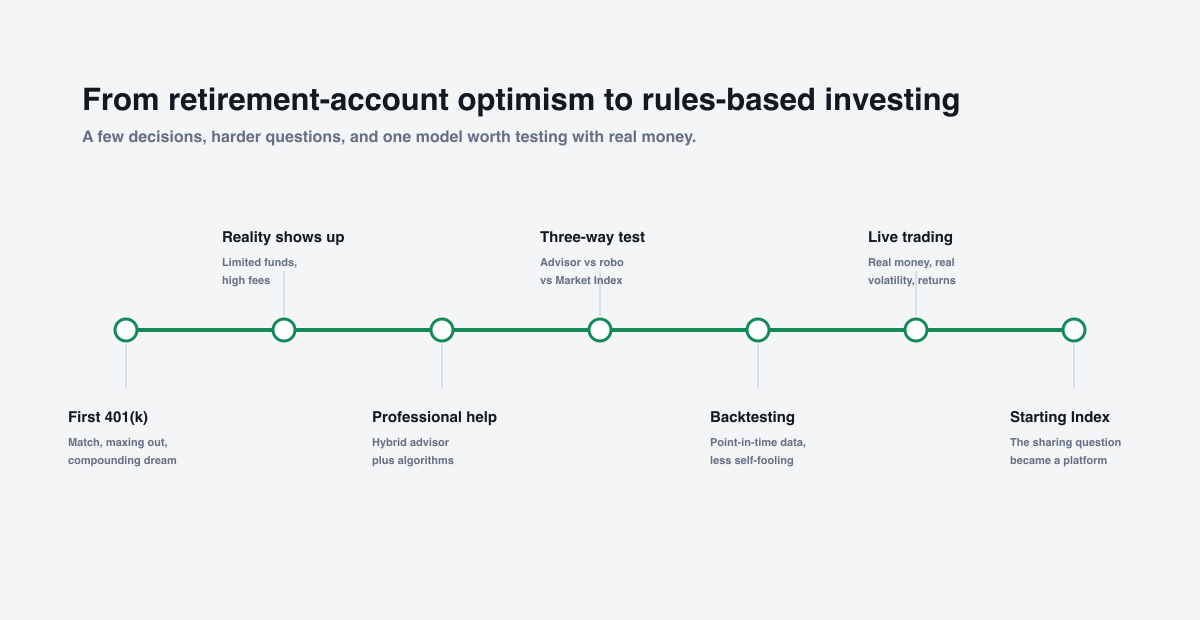
When I got my first job that offered a 401(k), I was excited. I could get the company match, start maxing out contributions, and finally build what felt like a "real" retirement account.
I had been investing in stocks since I was a teenager, but this felt different. Money that could grow tax-deferred sounded powerful. Almost magical, like it was the 8th wonder of the world.
Back in the late 1990s and early 2000s, teenage me had visions of a retirement account with more than $1,000,000 in it, compounding its way toward the retirement of my dreams. I had learned about compound interest in high school and understood the basic idea. Get the snowball big enough, give it enough time, and eventually momentum does a lot of the work.
Then reality showed up.
The handful of mutual funds in my 401(k) were not performing all that well. Even the ones with stretches of good performance came with pretty high fees (yes, I am dating myself here, but this was before ETFs became the default answer in retirement accounts).
Fast-forward through a few jobs, a few 401(k)-to-IRA rollovers, and a growing nest egg, and I could finally choose what I invested in. I tried individual stocks, broad index funds, and even IPOs (which, for anyone who has not experienced it, means trying to time an entry and exit inside a retirement account, an exercise in futility and frustration).
Some things worked and some things did not.
Then the very exciting, very official-sounding day arrived when I had enough money to qualify for professional money management.
I read, studied, and researched. Did I want a traditional advisor? Were these new robo-advisors worth my time? I was not sure. I chose a hybrid company with a personal advisor and automated algorithms to help guide investment decisions.
I gave them full control of my Traditional and Roth IRAs and thought, this is going to be amazing. This money is going to grow like nobody's business. They are professionals, they can certainly do better than me.
After 10 years, those accounts had outperformed the market in only one year.
Only 1 out of 10 years.
I had been paying for professional money management, and the result was that I underperformed the market. At first I was mad. Then I was sad. Then I was frustrated. I had handed over control, paid for the privilege, and felt like both time and money had been wasted.
At the 10-year mark, two things happened around the same time. I was laid off from my job, and the advisor connected to my account left the investment firm managing my money. He reached out to let me know he had moved to another company.
We hopped on a call and he explained that he had been limited in how he could structure client accounts at the previous firm, and that the new firm gave him more flexibility.
I thought, why not give it another chance?
But this time, I would run a test.
The old 401(k) from my previous employer was nearly double the size of my existing Traditional IRA, so I rolled it into two new Traditional IRAs and ran an experiment. The advisor would manage one IRA, a robo-advisor would get another, and the third would go into VOO, the Vanguard S&P 500 ETF. A three-way challenge to see how they stacked up against each other.
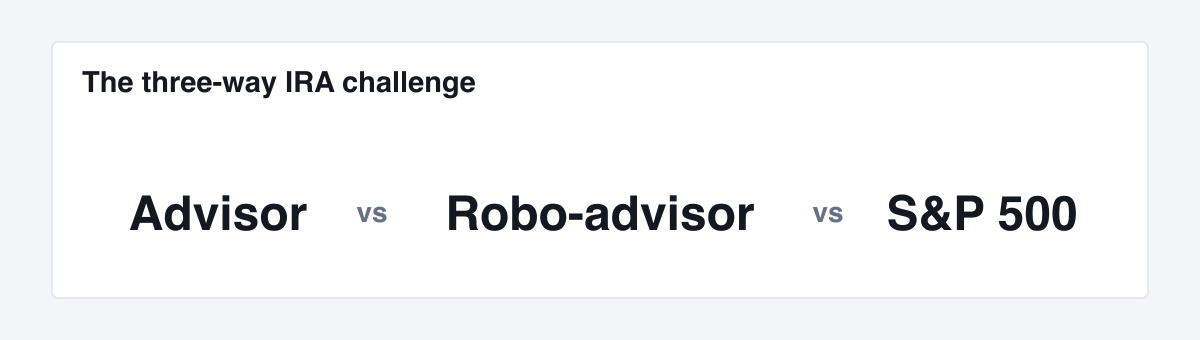
I would give it a year, compare the results, and decide what to do next.
A year later, the account simply invested in the market index was outperforming the professionally managed account and the robo-advisor account.
Paying to underperform made no sense.
To be clear, my money was not with some random firm no one had ever heard of. Across this period, it was with companies managing billions in assets, firms most people would recognize. Maybe a smaller RIA with fewer institutional constraints could have done better, I simply don't know. Maybe a different structure would have helped.
For the record, I do not think this means advisors are useless. Good advisors can help with planning, taxes, behavior, estate questions, cash flow, risk tolerance, and all the messy parts of money that do not fit neatly into a performance chart. My frustration was more specific. I wanted clearer evidence for the investment model itself.
Either way, I knew I needed to ask better questions.
After a lot of brainstorming, reading, and studying, I started backtesting strategies I had seen. I combined elements from multiple approaches. I made up my own. I tried a little bit of everything.
Some ideas did fine for a while and then broke down. Some never made it out of the gate. Some fell flat on their face immediately (which was rude, but at least efficient).
It was a humbling experience.
But, ever the optimist and hard-headed to a fault, I knew I could find something that would work. So I started from scratch. For years, I had used "the market" as my benchmark. It had its famous long-term return profile, and for whatever reason I just wanted to beat it.
I did not need to blow it away. I just wanted to outperform it consistently over time (easy, it can't be that hard right?).
In my mind, that meant I could reach my goals faster than average and maybe discover something useful along the way.
Then my big idea finally arrived, wearing the camouflaged disguise of common sense.
What if I built a portfolio using only stocks that were current constituents of the S&P 500?
Instead of trying to predict the whole market or find obscure companies no one else had discovered, I would still be buying a slice of the market. Ideally, I would be buying the slice that was leading, or at least the slice showing the strongest current performance.
Now I needed a way to evaluate roughly 500 stocks each month and find the ones with the strongest forward or upward momentum.
That is where the real work started.
From there, I tested ideas. A lot of them failed, which was humbling and occasionally annoying. Some worked for a while and then fell apart. Others looked great until I changed one assumption and watched the whole thing collapse.
That was the first real lesson.
A fantastic backtest is not the same thing
as a fantastic strategy.
So I slowed down. I rebuilt the S&P 500 as it actually existed month by month, going back roughly 30 years. I wanted the test to include companies that failed, changed names, were acquired, or disappeared along the way. The point was simple. If the strategy only worked in a cleaned-up version of history, it did not work. That work eventually became part of how I think about evaluating backtests and separating backtested, reconstructed, and live performance clearly.
The goal was to build a system that was as simple and elegant as possible. Something rules-based, repeatable, and hopefully better than my own experience of paying for an investment model that kept trailing the market.
Eventually, I had a strategy that matched my goals.
I began trading it at the beginning of February 2026.
The system was fully automated. Each month, it analyzed the market, produced the next allocation, and placed the trades. I wanted the process to be as simple as possible. Rules in, allocation out, no emotional bargaining in the middle.
I also needed time before sharing the results publicly. I wanted at least six months of live trading before saying much to anyone because I needed to prove to myself that it worked first. A good backtest is one thing. Putting real money behind it and watching it behave month after month is another.
Realistically, I knew it would probably take one to two years of live history before anyone outside my closest circle would take it seriously. And that would be fair. I did not want to have a few good months and start shouting from the rooftops that I had cracked the code (which would be both obnoxious and wildly premature).
But somewhere around month four or five, the results were doing better than I expected. The strategy had recovered from a rough March, kept climbing, and at one point peaked around a 52% return.
That is when the seed of Starting Index started to plant itself in my head.
Not as a business plan. More like a persistent question that would not leave me alone. If this keeps working, is it something I should share?
I launched Starting Index right before month six. A few early adopters came in using the month five allocations, which meant their first real month following along was about to be the worst month the strategy had seen live.
Then July arrived.
Month six was hit hard by a mix of world events and market news, and the account had a roughly -24% month. Not exactly the welcome basket you want to hand early supporters. That month has nearly recovered, but it was a real reminder that sharing a live model with other people is different from running one for yourself.
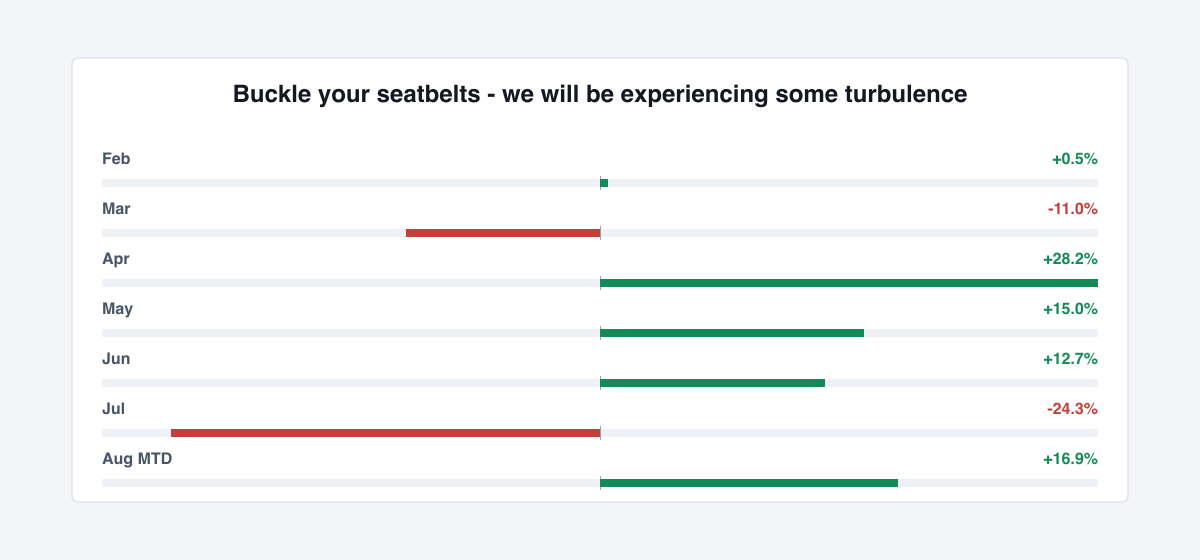
One thing was clear. There was volatility.
That is not surprising when a strategy allows concentration. If the strongest stocks are clustered in one part of the market, the model may lean into that strength. That can help returns, but it can also make the ride bumpier.
I also wanted to see the system as more than one profile. Instead of one model, I created Core, Balanced, and Growth.
I continued trading the original live account because I did not want to lose that history. Then I began trading the three defined models and reconstructed the prior six months for comparison. Those records are now separated on the profile records page because I wanted the distinction to be visible instead of buried in an explanation. The question was simple.
If each version had started on the same date with the same amount of money, where would each one be today?
As of this writing, here are the current returns.
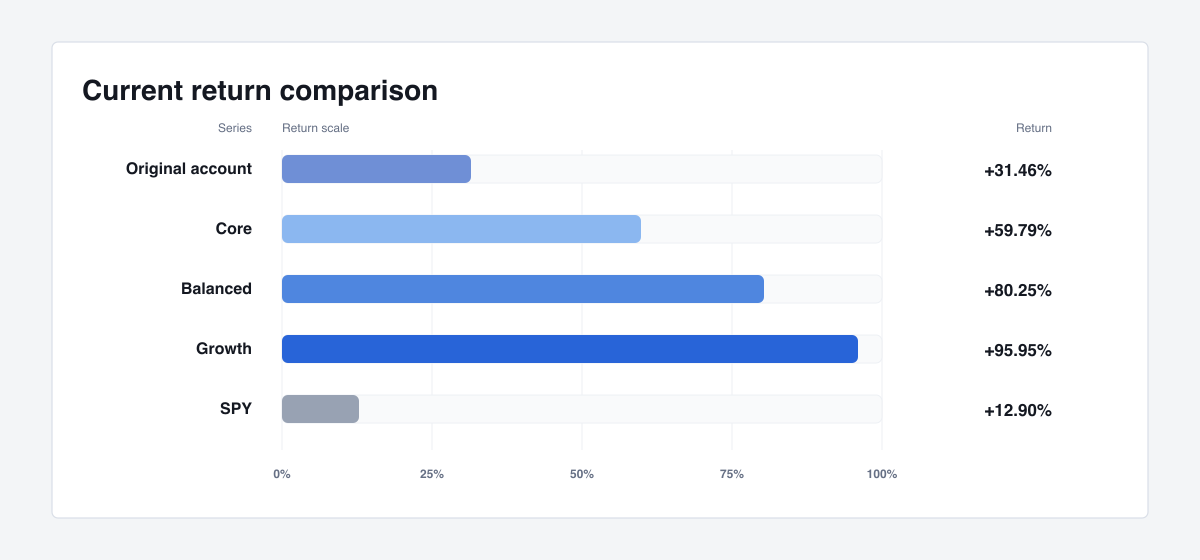
These numbers are exciting, but it is much too early to claim total victory.
The results have been compelling enough that the sharing question has become harder to ignore. I did not want to keep the work to myself, not after the frustrations that led me here. Sharing it meant thinking through what that actually meant.
That is what became Starting Index.
The idea is simple. Publish the model allocations, show the evidence, and let people decide whether the approach is useful to them. A self-directed investor can paper trade it. An advisor or RIA can evaluate it as a transparent model sleeve within their own process.
Once other people could follow the models, I changed the timing. My original live account traded near the close of the last trading day of the month. For Starting Index, subscribers needed the allocations before trading happened. I did not want to give myself a head start on the same model I was publishing, so I moved publication to an hour after market close on the last trading day of the month. Now everyone can have orders prepared before the first trading day of the month.
If you want to follow along, sign up for free and paper trade alongside the live models to see whether the approach fits how you think.
This is not personalized financial advice. It is not customized to your situation. It is rules-based, it ignores the news, and it follows a monthly reallocation cadence without interruption.
Starting Index is performing well so far, but it is still young. I am sharing it because the process, evidence, and questions behind it may be useful to investors and advisors who want a more transparent way to evaluate a rules-based equity model.
Now I am working toward one full year live. My goal is to help investors and advisors think more clearly about evidence, discipline, and what they should expect from an investment model.
Happy investing!
I am the founder of Starting Index and have a financial interest in the platform. This article is for informational and educational purposes only and is not personalized investment advice. Performance figures are early, may include live and reconstructed records where noted, and should be verified against the published Starting Index materials. Investing involves risk, including loss of principal.
Review the Live Platform Record, inspect the research evidence, compare profile records, or create a free account to paper trade alongside the published models.