What Does an Investment Track Record Actually Tell You?
7 min read

While hiking at Mount Rainier, I followed a path that changed quite a bit along the way. Some sections were paved. Others were well groomed, with steps and built-up sides. There were narrow stretches of raw trail, and farther up, snow-covered sections.
It was one continuous route, even as the surface changed underneath it.
A strategy's chart can look just as continuous. It can also begin years before anyone started following the strategy. Some of the history may come from research. Some may have been calculated after the fact. Another section may follow decisions recorded as the market moved, with or without real money involved.
The line can look continuous even when the evidence changes underneath it.
When I was building my investment strategy, I tested different configurations because I wanted to understand the tradeoffs before asking my retirement money to live with them. Concentration, weighting, and trading cadence all changed the result. The research mattered because those choices mattered.
But a historical test and an account following a process answer different questions. Putting them on the same page doesn't make them interchangeable.
For an individual investor, this is a useful place to slow down. Before deciding whether a return looks attractive, we need to understand what happened to produce it.
What the Research Can Tell Us
A research backtest applies a set of rules to historical data. It asks how a strategy might have behaved if those rules had been followed during that period, under the test's assumptions. The results are hypothetical, even when the market data is real. The SEC's Investor Bulletin on Performance Claims makes that distinction directly.
That makes a backtest useful for exploring an idea. We can study how different choices affect concentration, turnover, or the depth of a decline. We can look at markets the current strategy has never experienced in real time.
I've already written about the ways backtests can go wrong. Here, the point is simpler. Even a carefully constructed test describes a hypothetical portfolio. It doesn't establish that the decisions were made then or that anyone received those trading prices.
If the research covers an old market crash, we can study the strategy's simulated response. We still need to distinguish that from someone actually operating the strategy through that crash.
The useful question is what the research helps us understand, and which questions need evidence from somewhere else.
When History Is Calculated Later
In the first article, I described creating different portfolio profiles and reconstructing earlier history for comparison. That exercise asked how the versions might have compared if they had started together. It didn't mean each version had actually been operated throughout the earlier period.
That is the boundary a reconstructed model history needs to preserve.
Sometimes a model is applied to retained historical data after the fact. In that case, the reconstruction is a form of historical simulation. It can show how the model would have behaved under the stated assumptions, while leaving the real-time decision history unanswered.
Other times, someone recalculates returns from records of decisions already made. That can help repair or clarify a reporting history, but we still need to know what those records represent. Retained model allocations, simulated orders, and funded-account trades support different conclusions.
The word "reconstructed" alone doesn't settle any of that.
I would want to know what was retained, what was calculated later, and when the rules were selected. A result built afterward needs to be identified that way, even if it sits next to a forward record using the same model name.
This is less about rejecting the history than understanding what it contains. A useful comparison should leave us with fewer assumptions to make.
Following Decisions as They Happen
A forward model record begins with decisions captured before the outcomes are known. The allocations are recorded, the market moves, and the results accumulate according to a stated calculation method.
That gives us something a retrospective simulation cannot supply by itself. We can inspect what was chosen at the time and follow what happened afterward.
But we still need to ask whether the record represents a model calculation, a paper account, or a funded account.
A model calculation may track published holdings using assumed prices. A paper account may submit orders to a trading simulator. Both can operate forward in time. Neither establishes that real capital received those results.
Paper trading can be useful for practicing a process and observing its operation. Its execution remains simulated. Interactive Brokers, for example, documents differences between paper and live trading, including simulated fills and differences in how some orders behave. A simulator's result needs to be understood within those limits.
This is why "live" needs an explanation. It might describe a model being followed as markets unfold, rather than money invested in a brokerage account.
The reader shouldn't have to guess which meaning applies. The label should tell us whether the decisions were recorded beforehand and whether the execution was assumed, simulated, or actual.
Those are separate questions, and both matter.
What a Funded Account Adds
A funded-account record can show what happened when orders met the market and money was at risk. Actual holdings, cash flows, trading prices, and account records provide evidence that a simulation cannot manufacture.
That makes the account valuable to examine. It still needs context.
An account might hold different weights from a published model. It might trade at another time, leave some money in cash, or operate under different rules for part of the period. Those details affect whether it is a reasonable example of the strategy a reader is considering.
Deposits and withdrawals matter too. A growing account balance can reflect new contributions as well as investment returns. We need a calculation method that explains how the reported return treats that money moving in and out.
And even a well-documented account tells us about that account over that period. Someone following the same general process can receive different prices, face different costs, or make different implementation choices. Their experience may differ.
For me, the practical question is how closely the evidence matches what I'm trying to evaluate. If I'm looking at a particular portfolio configuration, I need to know whether the account actually followed it and for how long.
An impressive history under a familiar name won't answer that on its own.
Where the History Begins
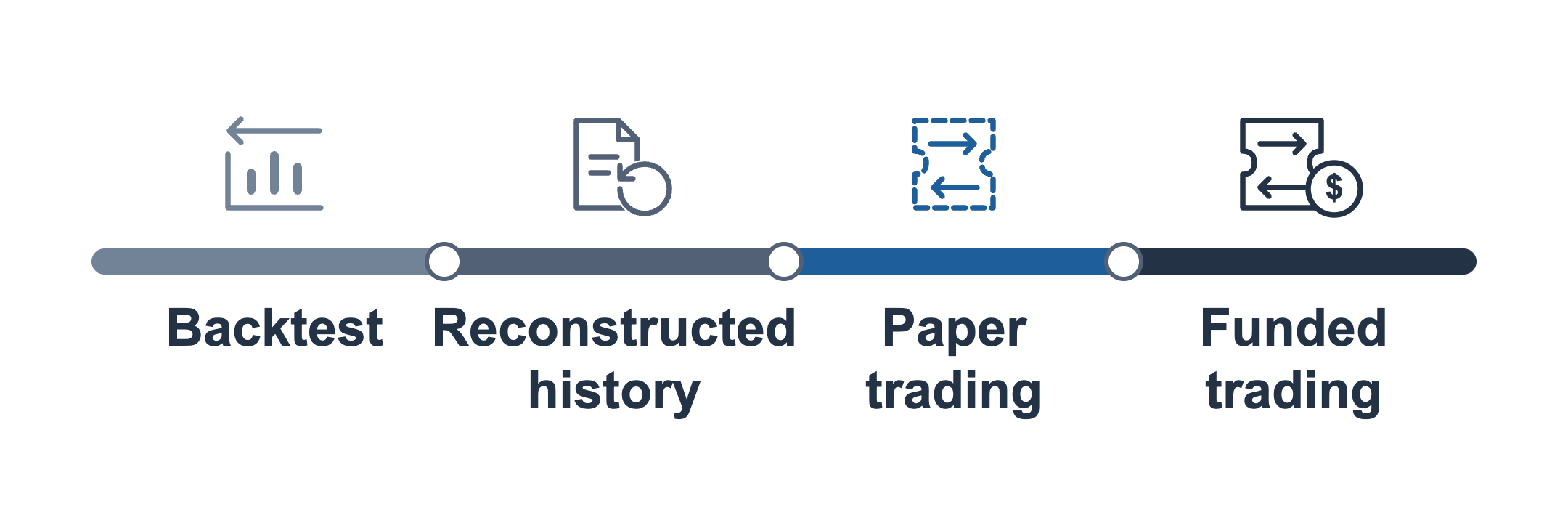
Imagine a chart that begins with historical simulation and later switches to forward paper operation. This is an illustrative example, not a description of a particular account.
The whole line may be useful to study. The date of that switch still matters. Only the later section can show decisions recorded in advance, and neither section establishes actual funded execution.
If a funded account begins later, it has its own starting point. Extending the display backward doesn't give the account an earlier beginning.
I would want those boundaries visible on the chart, close enough to the result that I can understand them while looking at it. Otherwise, I may come away remembering the length of the line and forgetting how much of it represents each kind of evidence.
The same care applies to a young record. It can tell us something about the period it covers. It leaves other market conditions untested in real-time operation.
More history gives us more to examine, but elapsed time alone doesn't answer every question. What happened during that time matters, along with whether the process being evaluated stayed the same. I'll return to strategy changes in the next article.
What I Would Ask Before Trusting the Number
We don't need institutional resources to ask for a clear description of a result. These are the questions I would start with.
- What produced this history? Is it research, reconstruction, a forward model calculation, paper trading, or an actual funded account? If the chart combines them, where are the boundaries?
- Which decisions were recorded before the outcome? When did that begin, and what records show it?
- Does this history represent the strategy I'm considering? Which rules and portfolio configuration were in use during the period?
- What is included in the return? How are cash flows, dividends, fees, and trading costs treated? Is the benchmark measured on a comparable basis?
- What can I inspect? Is there a clear method, dated history, and supporting record? If independent review is claimed, who performed it and what did it cover?
Being able to reproduce a calculation from retained records is useful. Checking our own work, or letting someone inspect it, is different from obtaining an independent third-party review. Even with an outside report, its scope matters. "Reviewed" should lead to an explanation of what was examined, rather than an assumption that the whole strategy has been approved.
For a professional evaluating a model for clients, these questions are a starting point for deeper work. For someone evaluating it for their own investments, they can help identify what needs clarification before making a decision.
Clear answers also leave room to decide the strategy doesn't fit. Evidence about a portfolio's history won't determine whether its concentration, drawdowns, or operating requirements suit our own circumstances.
Let the Record Answer the Question It Can
I started building a strategy for my own money. That is still useful context for how I think about the evidence. I want to understand the decisions, the tradeoffs, and the limitations well enough to make a choice I can live with.
Research can help explain an idea. A forward record can document decisions as they happen. Funded-account records can add evidence of actual implementation. Each leaves questions open, including the one every investor would like answered in advance.
What happens next?
Past results cannot settle that. Understanding their source gives us a better basis for judging what we know so far.
That is part of the work behind Starting Index. If you'd like to look more closely at the process, start with the method. Keep the questions above in mind as you read.