
Momentum Works, But the Details Matter
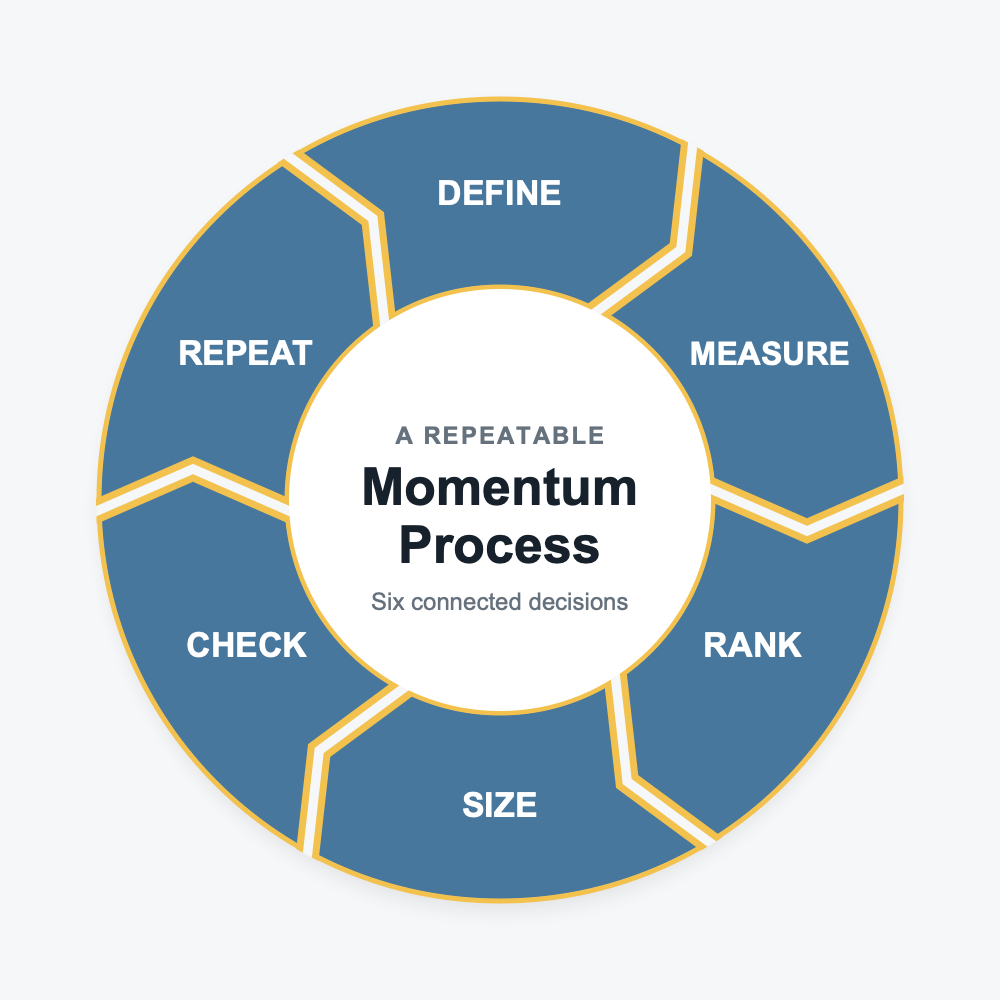
Momentum is easy to explain in one sentence. The decisions required to build a version we can actually follow are where the real work begins.

I know at first glance hiking and momentum investing don't have much in common, but hear me out. This analogy stuck in my head and I believe it's a great way to dive into this article.
If you decide to summit a substantial mountain, you need to do some strategic route planning. You need a route that can get you to the goal on a timeline that works for you, with a level of risk you're comfortable accepting, and without depleting all your energy along the way. If you don't see the parallels yet, that's fine. Keep reading.
The route itself probably won't be a steady climb. You may work your way up to a smaller peak, drop into a valley, and then have to climb again before reaching the next section of mountain. You can lose elevation without losing the route. From the trail, that descent can feel like moving in the wrong direction. From farther away, it may be one necessary part of an upward journey.
Momentum investing can feel a lot like that.
My goal in this article is to help you understand momentum, what we should consider when measuring it, and what decisions have to be made before we can feel comfortable with the result. Not comfortable because the route is guaranteed to be easy, but because we have enough trust in the planning to continue when the trail dips before climbing again.
Momentum Is Simple Until You Have to Define It
Momentum is often reduced to a sentence that sounds something like this: buy what has been going up.
That isn't entirely wrong, but it leaves out nearly everything that matters.
What are we choosing from?
How far back should we look?
Are we measuring one strong week or sustained strength over several months?
How often should we check again?
How many investments should we hold?
Should they all receive the same weight?
What happens when the market itself loses momentum?
Each answer creates a different strategy. Two people can both say they invest using momentum while holding completely different portfolios, trading on different schedules, and experiencing very different risks.
That is why the useful question isn't simply whether momentum works. The useful question is which version of momentum we are willing to live with.
What Momentum Is Actually Measuring
Momentum has a long history in market research. The basic idea is that investments showing stronger and more persistent price movement than their peers have sometimes continued to lead for a period of time.
That doesn't mean momentum predicts the future. It doesn't tell us what a company is worth, why its earnings may change, or where its stock price should be six months from now.
It measures what the market is rewarding now.
That distinction matters. A traditional investment process may begin with revenue, earnings, valuation, management, or an estimate of fair value. A momentum process begins with price behavior and relative strength.
There isn't necessarily a price target for each holding because the model isn't claiming to know the perfect price. There also isn't a separate story written to justify every company. A stock enters because it meets the same rules applied to every other eligible stock. It remains while it continues to qualify. It leaves when the next evaluation says something else deserves its place.
For me, that is part of the appeal. The process doesn't need me to correctly predict which product launch, earnings report, or news event will matter most. It asks the market to show where leadership already exists, then applies the same measurement consistently.
The Starting Point Shapes the Journey
Before ranking anything, we need to decide which investments are allowed onto the trail.
For the system I was building, I chose to begin with the individual companies in the S&P 500. That gave me a familiar and liquid universe of established companies while leaving enough breadth for leadership to move between businesses and sectors over time.
The universe matters more than it may appear.
A momentum strategy applied to small companies, international markets, cryptocurrencies, sector funds, or every tradable security would produce a very different portfolio. It would also bring different liquidity, volatility, data, and implementation concerns.
Even the historical version of the universe matters. A fair test can't take today's surviving S&P 500 members and pretend they were the only choices available 20 or 30 years ago. It needs to reconstruct which companies were eligible at the time. I covered that problem more fully in the previous article on survivorship bias, but the short version is simple. The quality of the ranking cannot rescue a distorted starting universe.
Choosing the universe is the first route decision. It defines where the system is allowed to go before it ever takes a step.
The Measurement Window Changes What We See
Once the universe is defined, we need to decide what counts as strength.
A stock can have a fantastic day because of an earnings surprise, a takeover rumor, or a piece of news. That may be meaningful, but one sharp move is not the same thing as sustained momentum.
Very short measurement windows react quickly. They also absorb a lot of noise. A longer window can identify more persistent leadership, but it may respond more slowly when conditions change.
In my own research, I settled on evaluating price-based momentum across a multi-month window. The goal was to identify leadership that had shown some persistence without turning every strong or weak day into a portfolio decision.
There is no perfect window that knows exactly when a move will begin or end. A useful window has to balance responsiveness with stability. It also has to hold up when the start date shifts, market conditions change, and reasonable assumptions are adjusted.
That last part is important. If a strategy only works when one exact measurement is used, I don't have much confidence in it. I want the surrounding choices to work reasonably well too. The goal is to find an area of durable behavior, not one perfect foothold that disappears as soon as we put weight on it.
Cadence Decides How Often We Change Course
Even after choosing how to measure momentum, we still have to decide how often to act on it.
A daily process can respond quickly, but it can also generate more turnover, trading friction, taxable activity, and opportunities to mistake noise for a lasting change. It requires more monitoring and more operational machinery as well.
A slower process will not catch every turn at the ideal moment. Sometimes it will continue holding a leader after a decline has started. Sometimes a new leader will emerge before the next scheduled evaluation.
I eventually settled on a monthly cadence. On that schedule, the eligible stocks are evaluated again, the rankings are refreshed, and the allocations are updated.
Monthly was not chosen because the market neatly resets at the end of each month. It was chosen because the research supported a repeatable rhythm that balanced responsiveness, turnover, and the practical realities of implementation.
It also gives the strategy room to work. A rules-based process becomes much less useful if every difficult week gives us permission to override it.
Selection and Weighting Are Different Decisions
Ranking tells us which stocks are strongest according to the model. It does not automatically tell us how many to own or how much capital to assign to each one.
That is where concentration and weighting enter the picture.
I tested several ways to turn the same ranked signal into a portfolio. A broader version held 20 names with limits on the largest weights. A middle version narrowed the selection to 10 and allowed more concentration. The most focused version held five names at equal weights.
The broader approach spreads the journey across more companies. The middle approach narrows the group. The five-stock approach places much more of the outcome in the hands of a small number of leaders.
None of those choices changes which direction the ranking points. They change how aggressively we follow it.
That is an important distinction for investors. A five-stock portfolio can move very differently from a 20-stock portfolio even when both begin with the same research. Greater concentration can amplify a strong period, but it can also make the valleys deeper and the daily movement harder to ignore.
The best choice isn't automatically the one with the highest historical return. It is the one whose concentration, day-to-day movement, and drawdowns fit the job we are asking it to do. A drawdown is the decline from a previous peak, and it can feel very different in a five-stock portfolio than it does in a broader one.
The Market Itself Gets a Vote
Ranking individual companies is only one part of the process. The broader market environment matters too.
The mountain gets a vote too. We can choose the route, prepare for the climb, and arrive ready to go, but if a storm is moving in, the smarter decision may be to wait. Heading onto an exposed trail in dangerous weather just because the hike was on the calendar isn't discipline. It introduces unpredictable risks and lowers the odds of reaching the summit safely.
Waiting does not mean abandoning the climb. It means respecting the conditions and preserving the opportunity to continue when the environment improves.
I also chose to apply a market-condition filter before treating the normal equity allocations as active. When broad market momentum is healthy, the model can follow the ranked leaders. When that backdrop weakens enough to trigger a defensive state, the model can step away from the normal equity allocations and use cash or a cash-like Treasury-bill alternative, depending on the account and implementation.
No filter will identify every market top in advance, and a rule based on observable conditions will always have some delay. Even with that limitation, it gives the process a defined way to respond when the broader environment changes instead of leaving the decision to fear in the moment.
Its job is not to make the journey painless. Its job is to provide a consistent rule for environments where continuing the normal climb no longer makes sense according to the model.
The Reward for Following the Route
The appeal of momentum starts with its ability to adapt as market leadership changes without requiring us to predict every change in advance.
Leadership can move from one company to another and from one sector to another. A momentum process has a consistent way to recognize that movement. When strength persists, it gives successful holdings room to keep working. When leadership changes, the next evaluation gives the portfolio a way to change with it.
That can be especially useful in a market where the biggest opportunities are not always obvious ahead of time. I don't need to correctly identify the company that will lead for the next decade. I need a repeatable way to recognize sustained strength, participate while it remains present, and reevaluate when the evidence changes.
Momentum also reduces the need to invent a new explanation for every decision. The same process is applied across the full universe. That consistency makes the result easier to test, easier to follow, and easier to improve when new evidence earns a place in the design.
At its best, momentum gives strong trends time to contribute while keeping the portfolio open to new leadership. That combination of participation and adaptation is what makes the climb worthwhile.
Progress Still Has Valleys
One of the harder parts of following momentum is watching a new high arrive and then seeing a meaningful portion of it disappear shortly afterward.
I have felt that discomfort in my own accounts. A new peak feels like progress finally made visible. The decline that follows can feel like something has broken, even when the account is still well above where the journey began.
Then, after enough time passes, another high may arrive. The progress becomes visible again, and the valley becomes one section of a much longer path.
That pattern takes some getting used to. Markets do not climb in clean diagonal lines. Momentum portfolios certainly don't. They climb, pull back, rotate, recover, and continue looking for the leadership that can carry the next part of the journey.
Just like the mountain, losing elevation for a stretch does not automatically mean we chose the wrong route. The rules help define what counts as normal movement, what will cause the portfolio to change at the next evaluation, and what broader conditions justify becoming defensive.
Those decisions are much harder to make while the account is falling.
Trusting the Work Between Evaluations
After a large decline, my first instinct is often to ask how I can keep it from happening next time. Could I add another exit rule, react earlier, preserve more of the gain, and then get back in at exactly the right moment?
It is a tempting line of thought. Every drop looks preventable after it has already happened, and I'm a problem solver through and through. The more valuable question is whether the decline revealed a weakness in the process or simply showed us one of the risks the process was built to accept.
But I have to remind myself of the work that came before the uncomfortable moment. I tested a lot of configurations. I analyzed the data. I looked for the edge, challenged the assumptions, and tried to understand the tradeoffs. The useful parts of that research are already baked into the strategy.
That doesn't make it perfect. It makes it researched.
There is an important difference between improving a system because new evidence reveals a durable weakness and changing it because the latest decline hurt. One is research. The other can become an emotional attempt to make sure the same pain never happens twice.
Staying the course does not mean refusing to learn. It means requiring changes to earn their place through evidence instead of letting one difficult stretch rewrite the route. When the research still supports the process, patience and restraint are decisions too.
Making Momentum Work in a Real Account
A useful momentum process has to make the trip from a historical chart into a real account. That means it needs to be practical enough to follow, not just impressive enough to study.
Trades have spreads and slippage, which is the difference between the price we expect and the price we actually receive. Taxable accounts may realize gains. Retirement and cash accounts may have settlement constraints. Different account sizes can produce rounding differences. Investors may place orders at different times or receive different prices.
Turnover, or how often holdings are replaced, matters because every change has a cost, even when a commission line says zero. A deliberate cadence gives trends time to work while keeping those costs and operational demands from taking over the strategy.
Behavior matters too. The practical version of momentum has to be understandable. We need to know what the system is measuring, when it changes, and what kind of movement comes with following it.
A clear and practical process is easier to follow consistently. It gives persistent leadership time to contribute and helps us distinguish expected movement from a legitimate reason to reconsider the design.
The Goal Is an Upward Journey
When climbing a mountain, the summit gives us a clear destination. Investing is different because there may not be one final top.
We may be investing for retirement, financial independence, a future purchase, the next generation, or simply the freedom that comes from having more choices. We decide how far we want to climb, how much risk we are willing to accept, and when the goal has changed enough to choose a different route.
The path will still have smaller peaks and sharp valleys. There will be sections where progress feels fast and others where we seem to give back ground we worked hard to gain.
The goal is not to avoid every descent. The goal is to participate in the climbs, adapt as leadership changes, and pursue long-term growth while staying within the risks we understood before the trail became difficult.
That is what the details of momentum are really about.
The universe, measurement window, cadence, market filter, concentration, weighting, turnover, and implementation rules all shape the journey. Momentum may provide the direction, but those decisions determine whether the strategy is one we can actually follow and give enough time to work.
These ideas eventually became part of Starting Index. The methodology, limitations, current profiles, and evidence trail are published throughout this site.
I am the founder of Starting Index and have a financial interest in the platform. This article is for informational and educational purposes only and isn't personalized investment advice. Backtests are hypothetical and don't guarantee future results. Investing involves risk, including loss of principal.